

Chongyang and Daoyin at an Autumn Turning Point Draft

By Angela J.H. Verkade
Imagine stepping outside on an autumn morning. The air feels different against your face. There is still warmth when the sun reaches you, but the shade asks for another layer. A familiar path looks slightly changed: more sky between the branches, a few leaves underfoot, the light falling at a different angle.
You may have walked here yesterday. Today, something makes you notice.
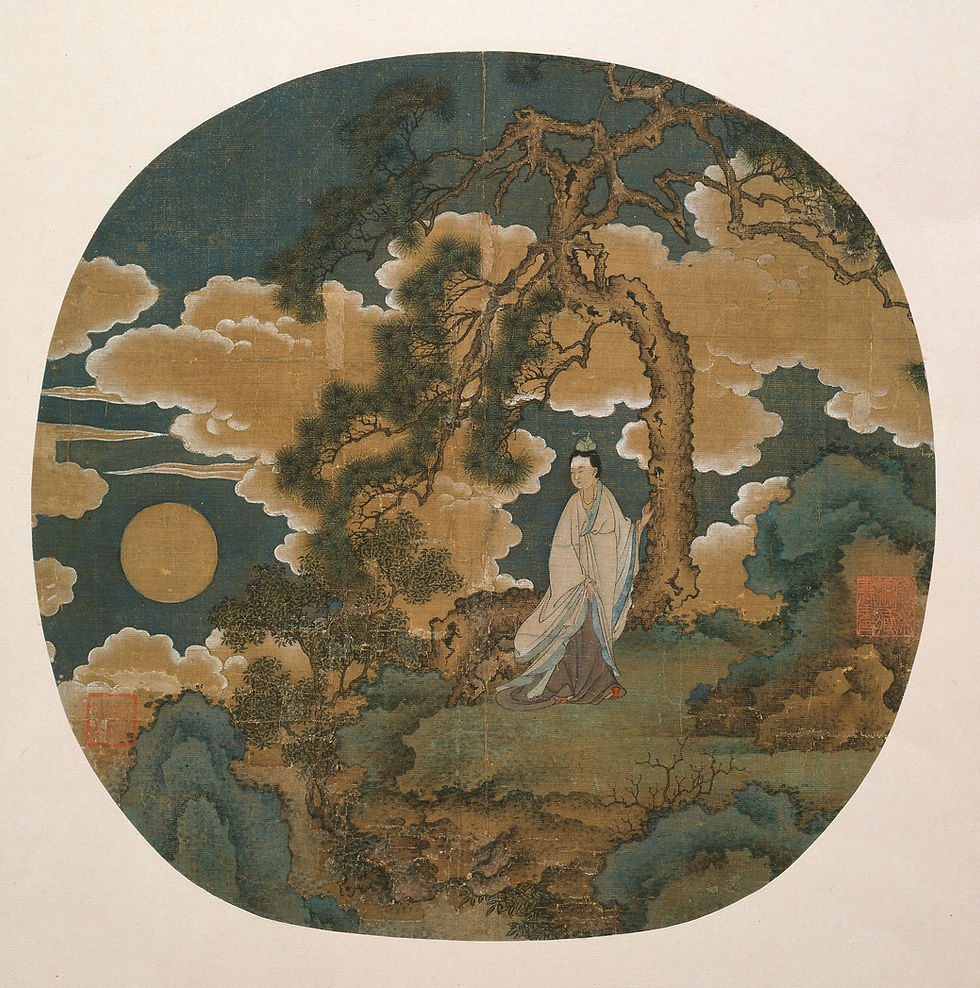
On 18 October 2026, the Chinese calendar brings us to Chongyang Jie 重陽節, the Double Ninth Festival. Its traditions include climbing to higher ground, gathering with others, enjoying chrysanthemums, and expressing wishes for a long life. Together, they give us a reason to pause in the autumn landscape and consider how we care for life as it changes.
The festival date and the changing season
Chongyang falls on the ninth day of the ninth month of the traditional Chinese calendar. Nine is associated with yang, and the repetition gives the festival its name. The sound of jiu, nine, also recalls jiu, lasting or enduring.
This relationship between the date and the wish for longevity appears in a letter attributed to Cao Pi, preserved in the seventh-century anthology Yiwen Leiju. The letter connects the repeated nine with lasting life and festive gatherings, and presents chrysanthemums as a gift associated with Pengzu, the legendary exemplar of longevity.
The calendar brings several rhythms into view. The months follow the moon, while the twenty-four solar terms mark divisions of the solar year. In 2026, Chongyang falls between Hanlu 寒露, Cold Dew, on 8 October, and Shuangjiang 霜降, Frost Descent, on 23 October. Its place among the solar terms changes from year to year.
The festival gives us a memorable date within that movement. The season itself continues to unfold around us. In southern France, an October afternoon may still be warm enough to sit outside, while the evening sends us looking for a cardigan. Elsewhere, the cold has already settled in. Paying attention begins with the surroundings we actually inhabit.
Climbing to higher ground
Climbing a height, denggao 登高, is one of Chongyang’s enduring customs. The landscape, the company and the shared meal all belong to the occasion.
One influential explanation appears in the Xu Qixie Ji, a collection of tales by Wu Jun from the Liang period. In the story, Fei Changfang warns his student Huan Jing that disaster will strike his household on the ninth day of the ninth month. The family leaves home, carries pouches of zhuyu, and climbs a mountain to drink chrysanthemum wine. When they return, their animals have died; the teacher explains that the animals have borne the calamity in their place.
The tale gives these customs a protective meaning. Other accounts and interpretations emphasize gatherings, seasonal outings and wishes for longevity. The festival has acquired different layers over time.
For us, a walk to a higher place can also offer a change of perspective. You stop beside a tree, turn around and see how far the path has brought you. A roof that filled your view below is now a small shape among the fields.
That is a reflection we can bring to the custom today. A little distance may help us see the relationships between things more clearly. And when we walk together, we notice another relationship: the pace that allows everyone to remain part of the outing.
Chrysanthemums and the wish for a long life
Chrysanthemums have a particular presence in the literature of Chongyang. Cao Pi’s gift links them with longevity; Tao Yuanming’s Jiuri Xianju places them in a garden on the Double Ninth, with the poet wishing for wine to accompany the occasion.
The flowers, the drink and the gathering make a long life something people can wish for together. Chongyang cakes add another expression of hope: gao, cake, sounds like gao, high. Associated with advancement and good fortune, these cakes were already part of festival customs in the Tang and Song periods.
Zhuyu has its own protective place in the traditions. Historical accounts describe it being worn or carried. The museum of the Beijing University of Chinese Medicine distinguishes the plants called shan zhuyu and wu zhuyu, arguing for the aromatic wu zhuyu in this festival context.
These customs belong to a world in which plants, seasons, protection and longevity were closely connected. Their historical meanings invite attention to how people hoped to preserve life, and to the ways those hopes were shared.
Today, the festival also has an explicit role as China’s Older Persons’ Day, established in the revised law that took effect in 2013. That gives the wish for longevity a practical question: what kind of company, dignity and care accompany the years we hope someone will live?
Sometimes care is quite ordinary. Making time for a visit. Listening without looking at the clock. Choosing a route that suits the person beside us. Asking what they would enjoy.
Autumn and the care of life
In yangsheng 養生, nourishing life, the season belongs to the circumstances of the person. Daily habits, activity, and rest are considered in relation to changing conditions.
The second chapter of the Huangdi Neijing Suwen/Yellow Emperor’s Internal Classic describes autumn through gathering and settling. Its advice includes retiring early and rising early, keeping the intentions peaceful and gathering the activity of the spirit. This is seasonal guidance within the classical medical text.
Read alongside the festival, it brings our attention back from the distant mountain to the shape of an ordinary day. Are we still following the pace of summer? Have we made room for our practice, or are we trying to fit it into whatever time remains?
The relationship between life and the passage of time will continue through this series. As we explore the Xiuzhen Tu 修真圖, the Chart of Restoring Authenticity, and the Neijing Tu 內經圖, we will return to the language of the inner landscape and the roles of sun and moon in Taoist cultivation. Festivals offer familiar occasions to begin looking; the changing cycles give us more to study.
Daoyin and space within the body
Daoyin has a long history within Chinese traditions of bodily care. In early China, it was practiced for therapeutic purposes and for maintaining life. Early medical manuscripts document these practices, which were also developed within later Taoist traditions.
The Zhuangzi, in the chapter Keyi, mentions breathing, movements associated with a bear and a bird, practitioners of Daoyin, and the longevity of Pengzu. The passage places these practices within a larger discussion that also describes longevity without reliance on Daoyin. Its perspective reaches beyond a single technique.
In our own Daoyin program, Prof. dr. Dan K.J. Vercammen begins with two closely related concerns: creating space within the body and guiding circulation. He explains how gentle stretching and attention to the position of the body work together. The joints, the bones, and especially the spine receive careful attention.
As we return to an exercise, we can begin to notice where we hold ourselves unnecessarily, how a position changes the movement and what becomes clearer with practice. The instructions give us something concrete to work with; observation develops as we repeat them.
This also connects with our Baxian Xinggong 八仙行功, the Walking Exercises of the Eight Immortals. Within our teaching, these form part of Yuanqigong 元氣功 and yangshengfa 養生法. Daoyin provides preparation for the walking practice. Each of the eight exercises draws on the qualities and emblems of an Immortal.
We bring these practices to Chongyang through their shared concern with cultivating and caring for life. The festival offers the occasion; our teaching provides the practice.
Our Daoyin program opens on Chongyang
On 16 October, we are opening our Daoyin program to the public. Through Dan’s explanations and demonstrations, you can learn the exercises step by step and return to the downloadable practice videos as you develop your own routine.
We have chosen this occasion because the care of life runs through both the festival and our work. It gives the seasonal reflection a practical continuation: time to stand, move, observe and become more familiar with the body through which we live.
Perhaps you will mark Chongyang with a walk, a shared meal or a little time among the autumn flowers. Perhaps you will begin a practice you have been meaning to explore.
When you return home, the season will still be moving. There will be food to prepare, a message to answer, and another day ahead. The attention we gave on the path can come with us.
With warm regards,
Angela & Dan
Sources
Dr. Dan K.J. Vercammen, introductions to Daoyin and Baxian Xinggong, Taoist-Lifestyle.Com.


Comments