

LINEAGE ESSENTIALS
Some Thoughts on What Denotes a Chinese Lineage
Issue 1
by Prof. Dr. Dan KJ Vercammen
This is a delicate and somewhat serious subject and I apologise for having to add footnotes to explain things. As the scorpion said to the frog on its back after stinging it when they were crossing the river to escape a forest fire: “I couldn’t help it.”1
An anthropologist doing fieldwork on so-called Chinese esoteric and secret transmissions, such as Taoist practices, traditional medicine and martial arts, can’t evade encountering — and even participating in — societies or groups of people who share a common interest and common practices that make up a body of knowledge that they convey or spread in a small or larger circle. The Chinese refer to such transmissions as “傳統 chuantong”. It is definitely interesting to take a closer look at what this actually means, because it explains a lot about how one should understand this.
The 傳 chuan character actually refers to the handing down2 from person to person of something; so, that’s the transmission. The second character, 統 tong, tells us about the characteristics of the transmission, since this graph can mean the end of a thread, to rule and/or to control, and to gather into one. Tong is like a thread, an uninterrupted tradition that controls what is being transmitted and is all about keeping the lineage one.
Transmitting in the traditional Chinese context needs the creation of a group of interested people that form an unbreakable bond and a body (a head or leaders, actually) that guards the characteristics of the transmission. In order to realise a successful transmission, several essential “items” must be created: a founder, representatives following in the founder’s footsteps, a body of knowledge that can be transmitted through practices and oral and/or written words, and rules/precepts/interdictions/rituals to adhere to. All these can be further developed and “complicated” as the history of the transmission unfolds by the input of successive generations. A simple transmission usually grows into something extremely complex after some centuries.
Let’s look at two examples, so we can observe how this rolls out in practice: Yang Style Taijiquan and the so-called Southern Tradition of Jindan (the Golden Cinnabar or Neidan [Taoist] Internal Alchemy).
Yang Style Taijiquan originated in Northern China (nowadays Hebei province and Beijing) in the late 19th and the early 20th century.3 Yang Luchan was the first practitioner of a martial art that he had invented by combining techniques and methods he had learned from the Chen clan in Chenjiagou (present Henan province) and in his birth region, Yongnian in Hebei.
After his move to the capital and his rise to fame as a fighter, interested parties gathered around him and his family to study what he excelled at. So, effectively, he wasn’t “alone” any more and a new tradition arose. He became the founder, had followers, and he had something to teach.
However, he also had a big disadvantage: he was an illiterate, simple worker-fighter without knowledge of how to set up a real continuous transmission. In the martial arts field, the transmissions that survive were kept alive by literate, wealthy patrons and practitioners and/or by traditions that included martial arts as one of their practices.4
Taijiquan as a tradition didn’t develop because of Yang Luchan; it developed because literate people, such as the 武 Wŭ family, became involved. They “found” classical texts about the principles, philosophy and practice of taijiquan, claimed that the art had another, older founder (the obscure Taoist Zhang Sanfeng5 of the Song or Ming dynasty), and started transmitting the art to insiders (and outsiders). The Yang family followed suit, the other 吳 Wu and Sun did the same, and so different styles took shape.6
All of these styles follow the same transmission pattern: you can become part of the lineage and then represent the style by adopting the rules and prohibitions, by being informed about the secrets7, by (when it’s your turn to transmit) teaching in a well-defined way, and by following the principles expressed in a certain interpretation of the classic texts. Unfortunately for Yang Luchan, this robbed him of his role of founder.
And it also required literate persons8 to actually carry the tradition, the Yang family members being the face of the tradition but not the real driving force. When taijiquan was shown and taught in different regions of China, many students wanted to learn the art. Not all could be members of the tradition, but those who were ended up on a list (錄 lu) circulated among the members and made known to outsiders.
With the passing of time, several tradition members added and changed the contents of the teaching, thereby, in fact, founding a new tradition (what we can call a sub-style), e.g. the Dong Style (started by Dong Yingjie, mixing Yang and Li/Wŭ styles, while at the same time inserting Dong’s own accomplishments).

The example of the Southern Tradition of Jindan, an alchemical transmission, is even more complicated. It already starts with the supposed beginning of the tradition. We have no evidence whatsoever that the presumed founder, Zhang Boduan (984–1082), started a “southern” tradition.
In fact, we can assume that this Southern Tradition was invented by Bai Yuchan, a Taoist of the Song dynasty.9 He probably traced back what he practised and wrote about to a famous predecessor in order to legitimise his position. We have seen the same practice with the adoption of Zhang Sanfeng as the founder of the taijiquan transmission. As with the taijiquan tradition, we see here that the founding of or existence of another tradition was the incentive to create a new path.10
In this case, Bai Yuchan faced the existence of a so-called Northern Tradition (Quanzhen) and therefore took the older southerner Zhang Boduan as the founder, so that what he transmitted was more original and older (and therefore more important) than what the northerners had to show for.
Classics were available: Zhang had written several and his followers had too. So, Bai drafted a lu, on which his name was written down as the current generation. A typical method with its own accents was also developed, placing it in some ways opposite to the northern method. One of the main differences being the stress on reinforcing the body and building a strong physical and mental foundation to be able to withstand the (side-)effects of rigorous practice.
In the northern way, more stress rested on Buddhist-inspired mental practices and associated ascetic techniques. The southern way was transmitted from teacher to student by koujue and specific training and it was open to non-Taoist practitioners. The tradition also developed into a 雙修 shuangxiu method, meaning a practice centred around a couple of practitioners or partner-oriented processes.
A substyle, called Yinyangpai or Yinyang Current, which is what we teach at Taoist-Lifestyle.Com, keeps this way alive. Although Bai initiated the southern way as a competitor of the northern lineage, it was the Northern Tradition that grew rapidly and strongly and, in the event, “swallowed” the southern version, so that it became part of Quanzhen and was reformed to a monastic Taoist tradition.
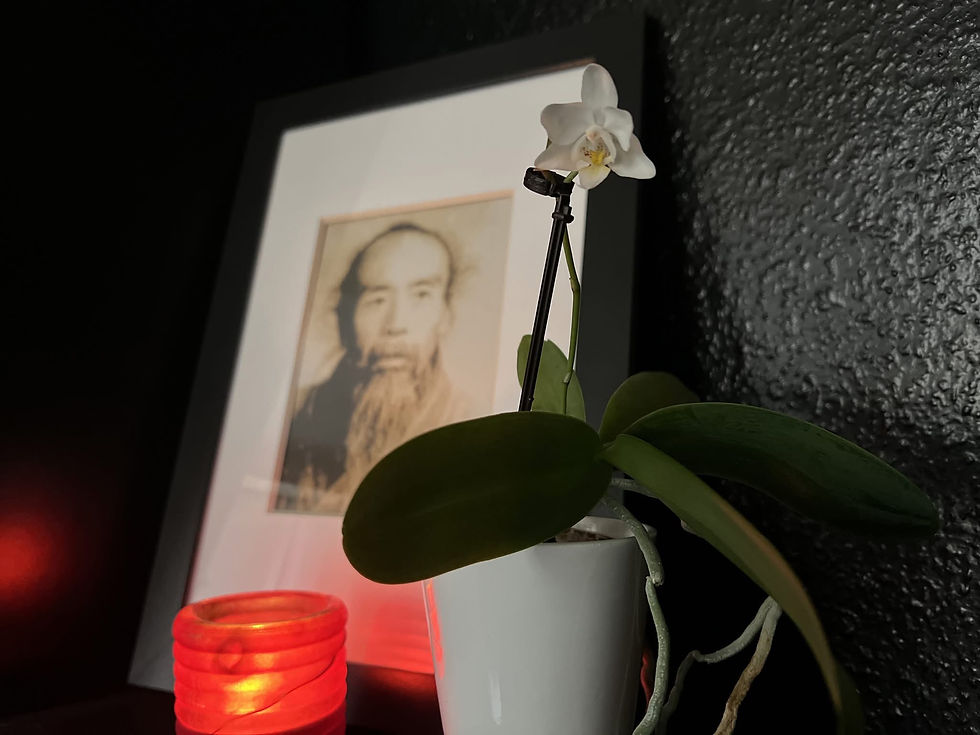
To preserve the original southern ways, members of the tradition went rogue and transmitted the koujue and practices clandestinely, in utmost secrecy. Some practitioners literally built high walls around their premises to protect themselves from prying eyes. Our Yinyang Current derives from this source and it retains the essence of Zhang Boduan’s teachings and practices (a socially inclined, engaging, and preferably partner-oriented practice), which is not about retiring from real life and practising on a mountain top, where the real world can’t disturb you. As Zhang taught: the real practice is done on the market square.
And then there is the matter of the difference between those within a tradition and those without. It is customary to create circumstances to protect the knowledge and the people carrying it. The members of the tradition are kept limited (although that’s relative; big traditions can have many members); secrets are carefully guarded and not transmitted outside of the group.
However, after some time the tradition will find a place in society and be known, and sometimes (this is certainly the case for teaching traditions) the members will be clearly seen as people associated with the tradition. It is also hard to keep secrets when the number of people who share them grows proportionally.
In modern times, when the practices can be observed, up to a certain extent be learned, and the texts (such as the taijiquan classics) can be found in publications, there will be students that cling to the gate of the tradition but that are not allowed in and don’t acquire the real essence.
In Chinese, the image of a gate (門 men) is literally used to differentiate between the outsiders and the insiders. The school or tradition is called a men (gate) and those who are real members are seen as “mennei” (inside the gate), the others as “menwai” (outside the gate).
The tradition is also perceived as a family: the teacher and his/her partner being the father and mother, and the disciples are the children (tudi or follower – young brothers) and each others’ brothers and sisters (xiongdi or older and younger brothers and jiemei, older and younger sisters). Those outside of the gate can be called students (xuesheng).
Formal initiation and an acceptance ritual are common when someone is allowed into the inner circle. This ritual is more or less the same in most traditions, but may be very formal, very casual, very simple or very complex, according to the tradition and the disposition of the people representing it. Some teachers are less concerned about initiation rites and take on promising xuesheng, treating them as tudi. And, of course, there are examples of low calibre teachers who officially take on tudi, without having much to teach them.
For us, the quality of the “wood” you’re made from is the most important. I’ve always taught motivated students in a mennei way without having them go through an acceptance ritual. And I’ve also tried having some go through an initiation ritual to see that experiment go awfully wrong … In my experience, the content I teach protects itself: those not interested in deep involvement but in quick results tend to quit quickly, while those really fascinated by and willing to put every effort into the mysteries of the practices will be able to open the gate to inexhaustible wonders.
Or, to quote the Old Master (Laozi) in the Daodejing (the Book of the Way and its Power): “The even more mysterious within the mysterious is the gate to all wonders.”
See: https://en.wikipedia.org/wiki/The_Scorpion_and_the_Frog.
The total graph even contains two parts that make this obvious: on the left is the character for person (亻ren) and in the lower part of the right half we notice 寸 cun, which is an inch or a thumb (can represent the whole hand).
I’ve been investigating the history of taijiquan since 1980 and published the results of my research in my MA and PhD theses (Ghent University, Belgium) and in several books and articles. In this article, I won’t go into the controversies around the origin of taijiquan as such, although I have sufficient proof to put forward an expert opinion. In my taking the Yang Style tradition as an example to show what transmission and lineages mean, I briefly state the historical facts of Yang taijiquan’s beginnings.
Shaolinquan, the fighting techniques of the Buddhist monks in the Shaolin temple, being the most famous example.
There are several Taoists named Zhang Sanfeng and most of what we know of them can’t be verified, as it mainly concerns stories.
The so-called Chen Style is an entirely different matter, which shows in their use of a different founder (Chen Wangting) and using different classic texts.
These are transmitted by 口訣koujue: oral formulae, accompanied by personal instructions and manipulations by the teacher. Koujue have been part of ancient transmissions (such as Taoist ones) for millennia.
A few examples: Dong Yingjie and Chen Weiming, who both published books for the Yang tradition (and Yang Chengfu in particular) to spread the principles and classics and explain to a serious, literate public that taijiquan could be of interest to them.
Traditional dates for Bai are 1194–1229 and some of his biographical details are quite “wild”. He wrote a huge amount of texts, which makes me (and others) doubt whether these dates are correct.
The initiative to form a tradition came from the Wŭ family, but Yang Luchan preceded them in the practice.


Comments