

Walk the Line: Centeredness and the Forgotten Principle of Bu Pian Bu Yi
- May 25
- 7 min read
“不偏不倚 Bu Pian Bu Yi” - Part three
WEN-WU FIELD NOTES

Issue 6
by Prof. Dr. Dan K.J. Vercammen
I hope you had enough to think about and practice after reading the previous two posts. Anyway, if not, here’s my next post to entertain you.
We continue with the remaining principles before linking them to the principle mentioned in the title.
The thirteenth principle: Internal and external join each other, breathing is natural.
(You should breathe out what needs to be exhaled and breathe in what needs to be inhaled.)
Breathing is natural! Don’t force your breathing and don’t try to co-ordinate your breathing with your movements. Allow enough time for your body to integrate the principles and transform naturally.
When you integrate the principles, you will notice after a while that your breathing changes together with your body’s changes. The internal and the external can then merge.
Don’t hold your breath; keep breathing. It is common to forget to breathe when concentrating on the movements, so try to notice this and simply begin breathing again.
When you are able to breathe in and out fully, this will greatly benefit your health. But don’t rush — be patient.
The fourteenth principle: Use yi, not li (force or physical strength)
Contrary to what most martial artists do, a taijiquan practitioner should not rely on brute force (li). We use focus, concentration, a relaxed mind and body, and continuous movement.
We are “slippery,” co-ordinate attacks and defences, align correctly, and make use of natural physical forces that are already there, such as gravity and the opponent’s movements. We try to be more clever than the opponent.
Mind you, this is about the practice of taijiquan, not necessarily about what you should do in daily life. You still need physical strength for many aspects of everyday life and should remain active if you want to maintain muscular strength and stay fit until the end of your life.
Don’t worry — the practice of authentic taijiquan includes demanding physical exercises, such as working with the long staff, which weighs several kilos.
The fifteenth principle: Qi moves all over the body, it partly goes up and partly down.
(It sticks to the back and sinks into the dantian.)
Qi is neither mythical nor mysterious. It is breath and all the activity caused by breath. It is also the communicator within your body, connecting you with the world outside yourself — for instance, through the air coming in and going out — and helping to keep you whole.
Qi naturally moves everywhere, but through taijiquan practice its workings can be enhanced. It strengthens the back and supports the elongation of the spine by influencing the backbone and marrow.
The source of this enhanced action is better, deeper, longer, and slower breathing, which allows the breath to reach the entire body.
The “sinking into the dantian” is an image for the abdominal breathing that becomes possible when the body is spacious and at ease.
The sixteenth principle: Yi and qi are interconnected
Awareness, focus, and attention influence your breath and the activities of your body. It is therefore impossible to separate yi and qi.
Training focus is possibly the most important aspect of taijiquan practice.
The results of this training require improving the movement of the breath so that the whole body can receive what it needs in order to react accurately.
The seventeenth principle: Obey the momentum of each pattern, don’t break it up, and don’t violate it; the whole body should feel comfortable
Movement should feel comfortable and easy.
I often tell and show my students that when a martial application does not feel easy or effective, they are either not following the principles or working against natural forces.
One reason why an application may fail is because the momentum is broken and the movement no longer flows.
When you try to push someone and feel resistance, don’t continue pushing. Instead, keep searching for the place where the opponent is not resisting.
The eighteenth principle: Each pattern should be even
(Not fast nor slow.)
Continuous, unbroken.
(The external patterns are like this, and so are qi and the internal energies.)
The patterns are unbroken, as mentioned in the previous principle. They should also be even.
During solo practice, you can follow the continuous flow of energies within your body and allow this to guide your external movement.
When practicing martial applications, continue following the opponent’s movements and make use of his or her speed without needing to move extremely fast or too slowly.
Let the opponent provide the speed and force.
The nineteenth principle: Don’t go too far and don’t fall short in the postures; strive to remain centered and upright
Remaining centered and upright prevents many mistakes.
Shifting your weight too far forward — for instance by moving your front knee beyond your toes — is going too far. This makes you unbalanced and allows your opponent to take advantage of your instability.
If you attack without putting enough weight into the action, the attack becomes weak and leaves you vulnerable. This is falling short.
Practicing stances and postures is an ideal way to study how to avoid such mistakes because it is relatively passive training. This understanding should then be tested through applications.
The twentieth principle: Conceal the applications and do not reveal them
If you think taijiquan is a soft, peaceful, and sweet practice, think again.
Taijiquan attacks vulnerable areas such as the eyes, throat, knees, and crotch. It includes throwing, sweeping, destabilizing, and other highly effective techniques.
It can therefore be extremely dangerous.
Better not reveal the true intentions and applications in the presence of the wrong people.
The twenty-first principle: Look for quietude in the movements
(The mind is quiet, without thoughts or considerations.)
Look for movement in the quietude.
(The internal qi is put to use.)
While moving, remain at ease. Don’t think — stay focused. This helps avoid unnecessary thoughts.
When at rest, you can become aware of how much movement is already happening inside the body.
By relaxing the mind, qi can move more adequately. You will feel better, remain healthier, and become more alert in dangerous situations.
The twenty-second principle: If you’re light, you’ll be nimble; if you’re nimble, you can move; and when you move, you change
This principle describes how movement should function in taijiquan.
As discussed earlier, when standing, you stand firmly — your feet stick to the ground. But movement is entirely different.
Heavy movement makes you slow and easy to hit. Therefore, move as swiftly as the wind and remain firm as a mountain — to paraphrase Master Sun, or Sunzi, the presumed author of the Sunzi Bingfa (The Methods of the Warrior by Master Sun).
Light, agile movement and continuous change create the best opportunities for effective defence.
Your opponent will have difficulty striking you if you continue moving and changing.
Even when practicing solo, train as if you are facing an opponent, even if you believe you will never need taijiquan for self-defence.
Twenty-two principles are already a great deal to absorb, but there are many more. Naturally, they all relate to and support one another. Discussing the bu pian bu yi principle demonstrates this clearly.
The actual meaning of bu pian bu yi is:
do not lean to one side or the other.
It closely relates to the sixth principle: keeping the body centered and upright. More specifically, it clarifies the meaning of “centered.”
When standing or moving, do not shift your centerline excessively to one side. Seen from the front, the centerline should remain between the legs rather than over one leg.
Take a look at the photographs of gongbu (bow stance) and dingbu (nail stance). We show both the correct posture and the pianyi problem — the opposite of bu pian bu yi — where the centerline shifts too far over one leg.
Begin with postures first and learn to maintain the centerline correctly before moving into dynamic practice. Keeping the centerline stable during movement is far more difficult.
Yes, this is the opposite of how many people learn today, where sets and choreography are taught first. Traditionally, however, martial arts were taught through structure and principles before movement sequences.
Why is this principle so important?

Because when your weight leans too far to one side, you are no longer balanced. You become unstable, and your opponent needs only minimal force to control you.
When too much weight rests on one leg, the pelvis and spine are usually no longer aligned correctly. Instead of remaining centered, the backbone curves, potentially creating back problems rather than solving them.

The overloaded leg also falls out of alignment, creating additional tension and increasing the risk of joint injury.
Even in static postures, an unbalanced position creates uneven and unhealthy circulation throughout the body.

When bu pian bu yi is not applied, many of
the other principles are negatively affected. Excessive shifting of the weight and poor pelvic positioning make several other principles difficult — or impossible — to apply.
How can you relax the neck and elongate the back when the pelvis is not centered and upright?
How can abdominal breathing function correctly when there is excessive tension throughout the trunk?
How can the knees remain loose when one side is pushed outward?
In taijiquan practice, one of the most important — perhaps the most important — achievements is learning to center and stabilize the pelvis.
I can describe this in many words, but ultimately you must feel and experience it yourself.
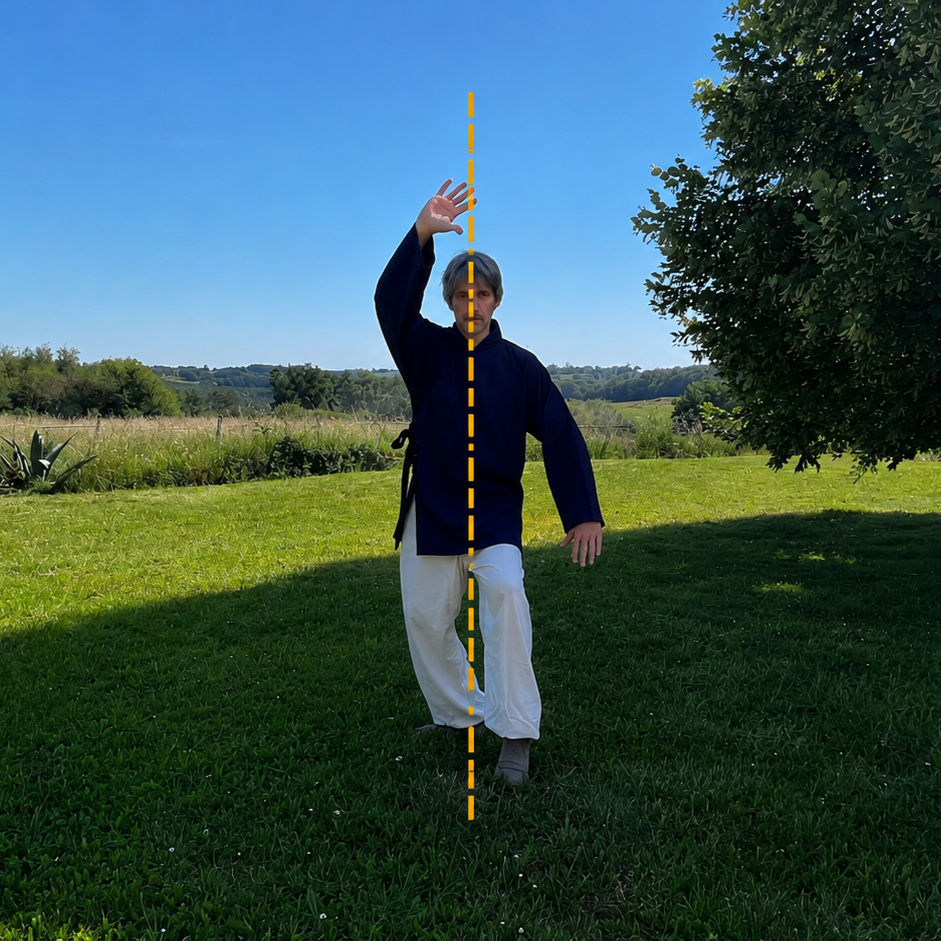
Finding the correct position without external guidance is extremely difficult. A teacher should constantly observe and, when necessary, correct the position, paying particular attention to the bu pian bu yi condition.
But of course, all the principles must be checked and applied.
So prepare yourself for a great deal of focused practice.
Keep in mind that neglecting these principles delays many of the beneficial effects that accurate taijiquan practice can bring — and may even become harmful to the body.
I am a man of principles in several ways.
Yet the use of principles should never lead to fixation.
Quite the contrary.
You apply principles in order to experience greater freedom — and that is certainly true for the principles of taijiquan.


Comments