

Talking about Practice and Theory: Entering the Minefield
- Mar 30
- 6 min read
Updated: Apr 1
GOLDEN CINNABAR LETTERS: Neidan (Internal Alchemy)

Issue 4
by Prof. Dr. Dan KJ Vercammen
We take a practical approach to Taoist internal alchemy. Generally speaking, most books and speakers on this subject talk about the three main steps in the traditional way (rather incomprehensible unless you already know the practice). You refine jing into qi, qi into shen, and refine shen to return to the void. Yeah, right. But what is jing, what is qi, and what is shen? Easy answer: essence (sperm?), breath or vital energy, and spirit. I’m sorry, but that’s not right. Why not? I’ll explain.
Unfortunately, you can’t just use one English word for a Chinese character that is multi-layered. That would, inevitably, lead to misunderstandings. You also can’t translate the classical Chinese alchemical literature into modern Chinese without context (the several layers). Even more problematic if you try to translate to English then. Especially in Western languages, we like well-defined words. Essence, breath, spirit. Not much to misunderstand. Mmm, yes, because you take the Western context with you and interpret the Chinese as if it is a Western language. And it’s not.
In fact, classical Chinese is the perfect language to write about alchemy. It is very ambiguous, even confusing. The same sentence can be translated in different ways, all grammatically correct interpretations. Just look up characters in a dictionary. Some graphs have tens of meanings …
Characteristic of Chinese characters is that most of them are not “words” but pictures, at least in their fundamental meaning. They draw a picture of what they mean.
An example: 大, pronounced “da” in modern standard Chinese; basic meaning: big, wide, great, because it shows a person with open arms and legs, as if this person is measuring something big. This character is simple, hence a relatively simple meaning, but some characters are much more complicated.
Take 藏, pronounced zang or cang, of which we use the zang pronunciation (which gives a different meaning from cang). At first sight, it makes no sense to the Western eye. Until you understand the different parts. The top (a horizontal line crossed by two vertical ones) represents grass or plants piercing the soil (top: leaves; bottom: roots). On the left, we see something that has two corners attached to a curved vertical line. It is a pattern of walls (seen from above), creating rooms, compartments, or spaces. Then we have the 臣 part, which means a slave, servant, or minister and is the representation of the eye of someone who looks up with the head bent. The right-hand part 戈 is a halberd.
So, the parts are walled compartments, plants, a slave or servant, and a pole-arm. Hence a meaning of “storage place”: a place containing plants (e.g. cereals), guarded by an armed servant. It is always important to try to see the picture that the characters draw when you try to interpret Chinese.
Now, if interpreting ordinary characters and their meanings is already a challenge, wait till you get to read alchemical texts. The authors like to play with characters and sounds, several layers of meaning, known expressions that are twisted to mean something else, etc. They do this both on purpose to mislead unwanted readers and also use it as a means to teach the alchemical practice. And they also want to reach their favorite public: spiritually inclined scholars.
So, there’s your minefield. I’ve now clearly marked the danger. Read the sign: do not enter without a deminer! You probably won’t be blown to smithereens in the minefield, but there’s a big chance that you’ll get completely lost. And that’s something we want to prevent and avoid. Another signpost (the teacher) says: take this way.
When you take a look at the levels we propose (ru/internalization, qiao-jiao/creating apertures and exchange, and chu/externalization), you won’t find these when you explore other teachings, books, or websites. That’s because they are based on the actual experience of the practice itself, not the theory behind it or the mandatory representation. It’s also because I know that a wrong interpretation of the common explanation of the steps leads to empty practice.
Combining authentic and extensive practice experiences, knowing the classical literature and the way to interpret it (based on the identification of theory with practice and vice versa), and, not in the least, the capacity to explain all this in comprehensible language and guide students along safe pathways is what makes us unique.
Getting back to the jing-qi-shen story, let’s explain this in a less classic way.
To tell you the truth, there is actually a lot to explain, correct, or clarify. Too much for this blog post. First, these three are often called the “three treasures” (sanbao 三寶), but they are not … at least not from the alchemical perspective. For the alchemists, jing, qi, and shen are just ordinary things, not the precious (reminds you of Gollum, maybe?) ones.
Precious are the yuan 元 (primary, united) versions of those three, i.e. you first need to proceed to uniting them, making them one through fundamental alchemical practice. It means returning them to a more original condition, not the condition they are in because you’re living your life.
Next, you could call jing some kind of “essence”, in the French sense of “fuel”, since it is what fires up the whole process. The qi you use is not the common qi 氣, but the refined qi 炁, represented by a character that contains huo 火, fire (in this character represented as the four “flames” at the bottom).
And the ordinary shen is what you use to think and to feel, whereas the shen that alchemists use is without thoughts and feelings. In fact, the three are not there; they are made of wu 無, nothing. Of course, they are not “nothing”, they are very real and create the transformations you go through, but they are not things like sperm (jing), incoming and outgoing breath (qi), your spirit or thoughts (shen).
In the days of the old alchemists, these three kinds of “nothing” couldn’t be recorded or measured, but nowadays they can probably be studied as a kind of brain activity and hormonal changes. To put it simply, hormonal changes starting in the reproductive organs cause a chain of reactions throughout the body and transform the practitioner physically, mentally, and emotionally.
This is indeed a gradual process and (most of the time) an ever subtler one, which is what the three traditional stages express.
Messing with hormones should be done with care, as endocrinologists will tell you. They usually work with artificial material. An internal alchemist works with her/his own material. But both ways require the assistance of a specialist.
The alchemical specialist will guide you to boldly go where (s)he has gone before. If (s)he hasn’t been “there” (as far as possible), (s)he should refrain from guiding others. You wouldn’t trust an ordinary person to treat you with artificial hormones either, would you?
A real, truthful, experienced alchemist will tell you from the beginning that you’ll go through a very profound change and will discuss with you if and how far you want to walk this way.
Now, back to the three levels we mention: ru/internalization, qiao-jiao/creating apertures and exchange, and chu/externalization. Why do we deviate from the usual steps? We don’t! We still practice in this way, but we describe in a different way what happens to you.
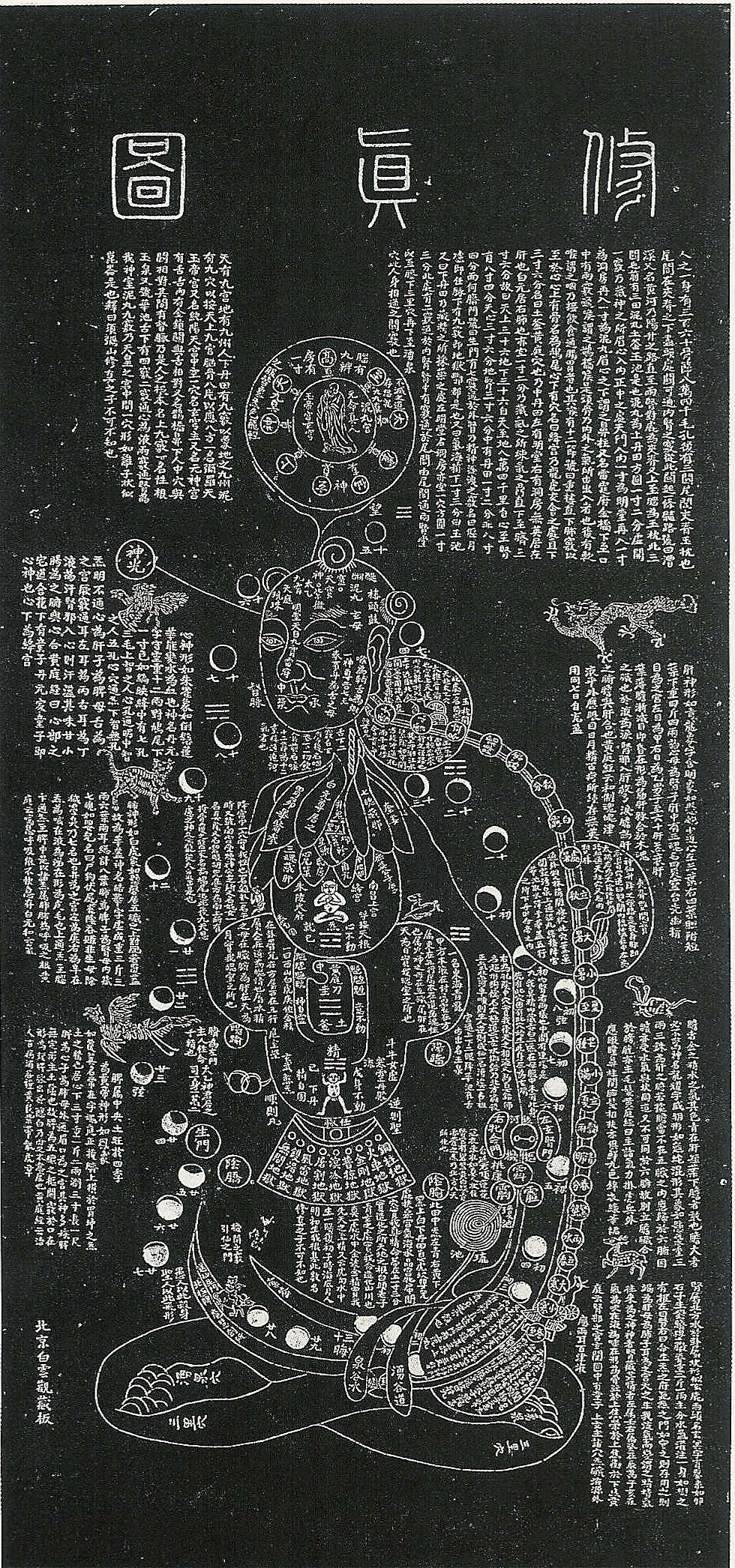
Internalization is about getting less distracted by your senses that lead you away from your inner self. The first step is therefore leaving as much of the outside world behind as possible. Concentrate on what’s inside. Several practices will help: repositioning your body, caring for your body and health, regulating breathing, enhancing your focus, working on your personality, making your hidden force come alive, etc. We have our specific ways.
The middle step is to understand the workings of your body better and find spaces and connections that you never knew were there. This is a fun part, kind of diving into the ocean or traveling through outer space, but inside your body. So much to uncover and discover! And knowing your own body’s capacities better makes you also more aware of how other people and creatures function.
The third step sounds scary: externalization means outside of your body. You’re leaving the safe capsule and making a moon- or spacewalk. Don’t worry, you’ll be well prepared and will enjoy it. Like an astronaut or a diver, you’re in some way connected with where you start from (your body) and can return there.
It does not end there. Internal alchemy is a continuous process of refinement. The gate of wonders is open. You’ll become wiser, stabler, more intelligent, peaceful, …
These steps of ours should give you a clearer picture of what to expect. And if you’re ready, my predecessors and I can take you there by making you really enter your body.
Upcoming Events
Related articles:


Comments