

Neidan: A Matter of Life and Death
Thoughts on Immortality

GOLDEN CINNABAR LETTERS
Issue 5
by Prof. Dr. Dan KJ Vercammen
In a way, Taoist internal alchemy can be seen as a quest for immortality. Why? Well, probably Laozi, the Old Master, is to blame for that. He inspired and keeps inspiring aspiring Taoists to unite with Dao, which, according to Laozi’s Daodejing (the Book of the Way and Its Power), is eternal. Therefore, we may assume that once you succeed in the union with Dao, you become immortal.
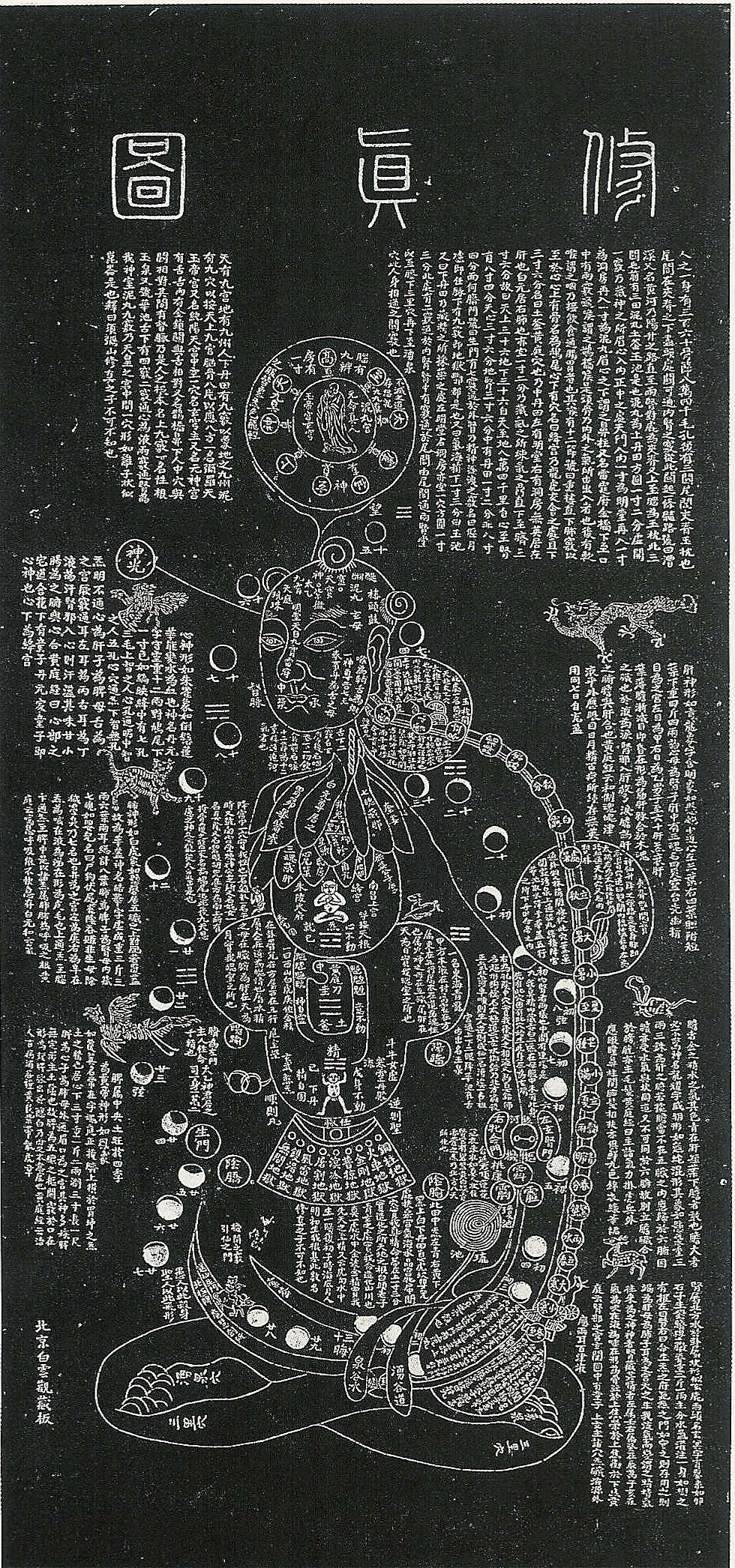
Taoist internal alchemy can be called 仙術 xianshu in Chinese, which most would translate as “the art/techniques of the immortals.” But… translating 仙 (xian) as “immortal” is not right. It is not, because the character shows an entirely different meaning, and because reducing xian-ship to being immortal does not do it justice. What this version of the character 仙 shows is a mountain-person or a person-mountain, referring to practitioners retreating to the mountains to practice and to develop a body that is firm and stable like a mountain (even resembling a mountain, as represented in the Nei Jing Tu, the Chart of the Internal Pathways).
We all think about life and death, and this leads to aspirations, considerations, and acts. Many people want to live as long as possible; some want to live an intense life, not caring about whether this shortens their lifespan; others want to enjoy life to the full but worry about the impact on the length of life. Scientists look for ways to prolong life and, in that way, can actually be called followers of the old alchemists. Fear of death can be a strong motivation to live. Fear of life can be a strong motivation to choose death. Understanding both life and death is key to getting rid of fear.
I did and do “think” a lot about life and death. In fact, it’s a daily challenge. Practicing internal alchemy and related practices, and studying the writings and lifestyle of the Taoists, has helped me greatly to understand creation, transformation, and destruction, which is the cycle of life/existence and death/non-existence.
In this post I’ll shed some light on Taoist views on life and death and how these views relate to the practice of internal alchemy. I’ll be using the words of some great Taoists like Laozi, Zhuangzi, and Zhang Boduan, the ancestor of the Southern alchemical tradition.
Taoists, in general, hold a positive view on life: they like it and practice yangsheng 養生, the feeding or cultivation of life. In this respect, a Buddhist view of life as suffering does not accord with a Taoist life. The Taoists view death as a part of life or the source of life, and life is seen as the root of death.
It is obvious, when you read Taoist literature and investigate the many practices to improve and prolong life, that a long life is an essential goal in a Taoist way of living. So, maybe Taoists do fear death? Why search for immortality if you see death as a part of life?
I’m sure that Taoists indeed prefer life over death. But that doesn’t mean that they do not accept death or are afraid of it. Once you understand what death really is, there’s no need to be frightened. And so, you need to die to “understand” it. You may think now that it is impossible to understand anything once you’re dead. You’re right. Understanding death does mean that death is the end of your life, of you, of your thoughts and feelings. Yet it’s the beginning of something else. And there are different ways to experience death. Some don’t require dying.
Within Taoism, different ideas about dying, being dead, and being immortal exist. We Taoists believe that there is not one truth, or that what we know is absolute. Feel free to disagree with me—that's only natural and interesting. It can move us on toward new perspectives and insights. Let’s ask Laozi, Zhuangzi, and Zhang Boduan what they have to offer.
"Although human life may last for a hundred years, Longevity, dying young, their limits or continuation, no one knows in advance. You were walking your horse yesterday in the street,and this morning you’re already a corpse sleeping in your coffin.Your spouse and fortune would be left behind, as they are not your possessions. It’s hard to fool yourself when karma for your guilty actions is about to prevail. It’s a struggle to chance upon it if you don’t go searching for the Great Medicine,and coming upon it but not refining it is foolish and idiotic."
From Zhang Boduan (984–1082), Wu Zhen Pian 悟真篇 (A Piece About Awakening to Authenticity), second verse; my translation.
Zhang Boduan is (one of) the most influential alchemist(s), not in the least because of his Wu Zhen Pian. He was a revolutionary alchemist, and all known alchemy practitioners and writers that came after him developed their methods on the foundations he transmitted. In the Southern Tradition he is honored as the ancestor or first generation of the tradition.
In this verse, Zhang tries to motivate his readers to pursue the path of internal alchemy. He does so by sketching the transience of human existence. As he was also trained as a Chan (Zen) Buddhist master and taught Taoist alchemy to Buddhists, he stresses the retribution that awaits if you accumulate bad karma.
Death can come quickly—you never know when—and you can’t take anything or anyone with you. Without practicing Neidan (called the “Great Medicine” here, after one of the accomplishments of the practice), at best you can live a long life. By this he seems to imply that Neidan leads to more than a normal long life, and he indeed clarifies this in the thirteenth verse:

"When all Yin is completely eliminated and the cinnabar comes to full ripeness, You shall leap out of the ordinary cage and live for ten thousand years."
(Almost) being immortal—is it not?
By way of the practice of Neidan one can realize this, and you would be foolish not to look for ways of achieving this, according to Master Zhang. Remember: it’s not a matter of just finding the “Great Medicine”; once you find it, it needs to be refined (lian 煉, which means “refining by fire” and is interchangeable with lian 練, meaning “to practice”).
Only through the refining practice can Yin be eliminated and cinnabar (the alchemical practice) ripen. Clearly, Zhang takes the viewpoint of a classical alchemist: surmount the conditions of ordinary life and death and reach longevity by Taoist alchemical practice. Mind you, how to interpret longevity or immortality is not a well-defined concept. Different authors and different practitioners cherish different views.
The practice of Neidan is done to find the Dao and join with it. It roots in the ancient Taoist lifestyle, propagated by Laozi and Zhuangzi. Time to concentrate on what they have to say.
Laozi is supposedly the author of the Daodejing (Book on the Way and Its Power), a relatively short text dating from the fourth or third century BCE. Laozi himself is thought to have lived a few centuries earlier, but of that we are not certain.
Throughout the book, the Old Master often refers to eternity, to remaining, to returning (to the roots). It is about Dao that he speaks, because he explicitly mentions that Dao is long duration and that dying is not being in danger (chapter 16). Because the Daodejing is considered the fundamental writing of Taoism, every Taoist is familiar with its content and follows its lead. Hence the interest in longevity.
What happened a few centuries after the spreading of the Daodejing text is that people, inspired by its words, founded communities along its ideas, but they also interpreted it in their own way and made Laozi the personification of Dao—which meant that Laozi became “immortal.”
Maybe we should take a look at the Zhuangzi for more information about life and death in a Taoist perspective. Life is certainly held in high respect by Zhuangzi, as you can read in the first issue of my blog on Zhuangzi for Cultivators (Freedom in the Mud).
But deadly diseases and death are a frequent theme in the Zhuangzi: several people’s deaths are described in the text. Zhuangzi’s wife dies; Zhuangzi himself, too; and even Laozi dies in the Zhuangzi.
Zhuangzi doesn’t seem concerned about death or about being buried or not (see chapter 32; this is a very extraordinary view for a Chinese, because not being buried is ordinarily considered a disaster). When his wife dies, he’s seen and heard making music on his pots and pans the morning after and doesn’t seem sad.
He knows that dying is not the end, but brings about a condition where there is no life and no death: Dao. That which brings about life doesn’t live. That which brings about death doesn’t die. In Dao is stillness, freedom of human constraints.
And Zhuangzi knows this because he already has experienced this condition during his lifetime by the profound and continuous practice of “sitting and forgetting” (chapter 6).
By the way, Zhuangzi is a fine source of information about what can be achieved by Neidan, a practice which is known for expressing the view that an accomplished alchemist needs to have died.
One sobering last idea about life and death that comes from the Zhuangzi: life is Qi coming together, death is Qi separating. Indeed, when that which holds us together leaves our bodies, we die—only to make the joining of Qi in another form possible.
Qi is Dao, Dao is Qi, the Taoists say. Or: Qi is our way to the union with Dao and immortality. Now what is Qi? That’s food for another post.
To conclude: some of the side-effects of Neidan practice are taking away the fear of death by understanding what it is, and getting more out of life than usual through breaking out of the limits of human existence—the ordinary cage mentioned by Zhang Boduan.


Comments